

Nottinghamshire County Council (NCC) was successful in securing funding from the Department for Science, Innovation and Technology’s (DSIT) (this will open in a new window)Digital Inclusion Innovation Fund (DIIF), a key delivery programme within the Government’s Digital Inclusion Action Plan. Through this programme, the Council wanted to contribute to a national evidence base that will help shape future policy and enable effective interventions to be scaled and replicated.
To support this, NCC identified the need for a novel, place-based approach through the development of a Digital Inclusion Spatial Equity Assessment and Mapping framework and commissioned FarrPoint to deliver it.
This built on the Council’s Digital Connectivity Framework and extensive consultation with partners across the county.
Although a range of digital inclusion initiatives were in place across the County and Nottingham City, there was no single, clear picture of provision or where gaps remained. Without a shared, data-backed evidence base, it was difficult to target investment, coordinate partners, or avoid duplication
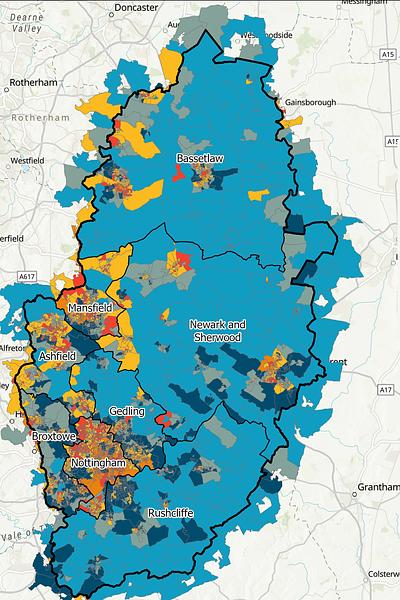
The project used a mixed-methods, place-based approach to understand the digital inclusion landscape across Nottinghamshire and Nottingham. This included spatial analysis to identify areas and communities at greater risk of digital exclusion, using clear indicators of need supported by mapping shared with the Council.
FarrPoint worked closely with NCC, local organisations, service providers and residents, using research, interviews, workshops and site visits to understand their experiences. By bringing together data and real-life insight, we built a clear picture of where digital exclusion exists, the challenges people face, and where support can make the biggest difference.
Building on earlier engagement through the NCC Digital Connectivity Framework consultations, partners were committed from the outset. Their continued involvement meant they felt informed and invested, leading to strong participation and enthusiasm in shaping and supporting the findings.
FarrPoint delivered a data-driven assessment of digital inclusion in Nottinghamshire, summarised in a comprehensive report with clear, actionable recommendations, along with accompanying mapping and dashboard portals to help the Council with implementation.

This study was important to us because it brought together data and local insight to give a much clearer picture of need across Nottinghamshire. FarrPoint has helped us create a shared evidence base that partners can use to coordinate activity, target support, and deliver better outcomes for residents.
Ian Stoddart, Digital Connectivity Service Manager at NCCThe digital exclusion mapping tool identifies the areas of greatest need. This mapping considered multiple dimensions of digital exclusion, including access to connectivity, affordability and various geodemographic characteristics, which allowed us to highlight spatial patterns and pinpoint areas and communities most at risk and create Digital Exclusion Scores.
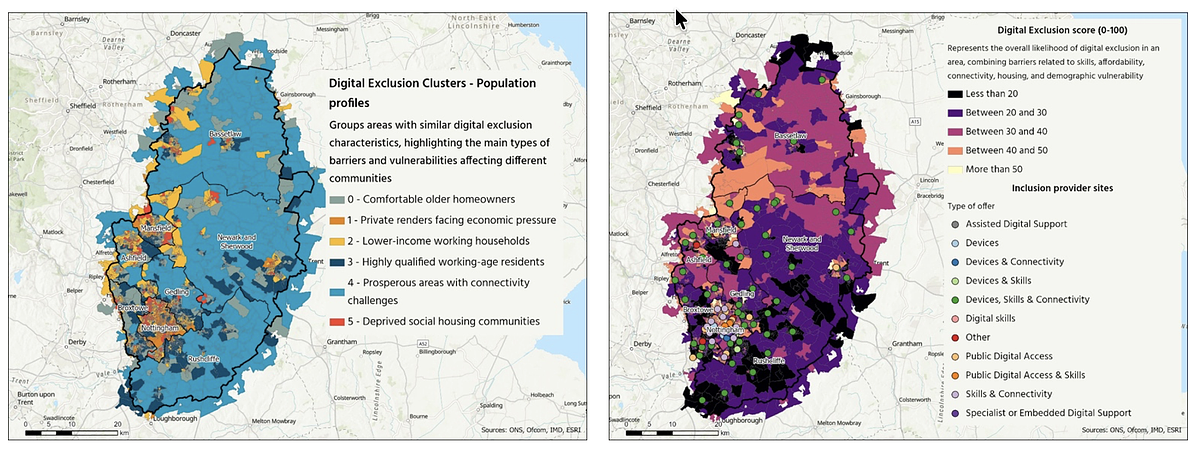
We then combined this exclusion map with existing digital inclusion provision to carry out a spatial equity assessment. This gap analysis identified areas where support is limited, misaligned or completely absent, to highlight opportunities for more targeted, coordinated and place-based interventions.
Nottinghamshire County Council now has a clear, evidence-based understanding of who is at risk of digital exclusion, where support exists and where further action might be needed. This can be used for effective decision-making and future investment in digital inclusion initiatives.
Ultimately, it allows the Council to move digital inclusion from a broad issue to something more actionable, as well as having a platform to bring in partners and help them understand need, recognise effective practice, improve coordination and commissioning of place-based support.
A core deliverable of the project was a repeatable methodology and framework that enables consistent, high-quality assessment of digital exclusion. This approach has been designed so it can be adopted by other organisations, supporting the generation of comparable evidence and helping to build a stronger understanding of “what works” when targeting support.
By making the process clear and transferable, it reduces duplication and allows others to benefit directly from the learning developed in Nottinghamshire.
One of the real strengths of this work is that it's not a one-off piece of analysis. It gives us a living framework that we can continue to build on, update and use over time, helping us respond to changing needs and keep improving how we target support
FarrPoint has extensive experience in mapping digital exclusion and generating practical solutions for tackling this across diverse regions.
Contact us to find out how we can help.
Connectivity is important. It drives business and society, bringing communities and commerce together. That's why we use our insight and experience to connect people and business.

