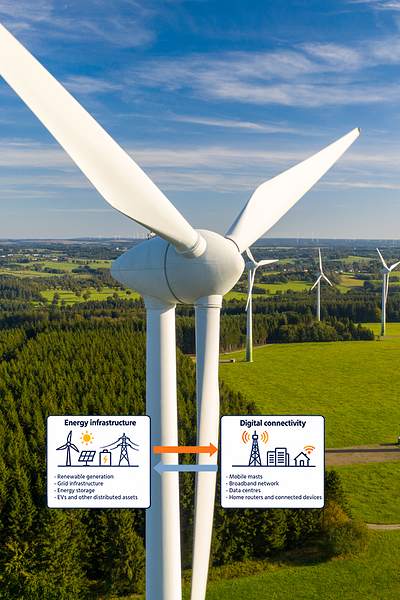
Article by Dr Andrew Muir, CEO at FarrPoint and Eric Brown, Energy Systems Director at Grid Scientific

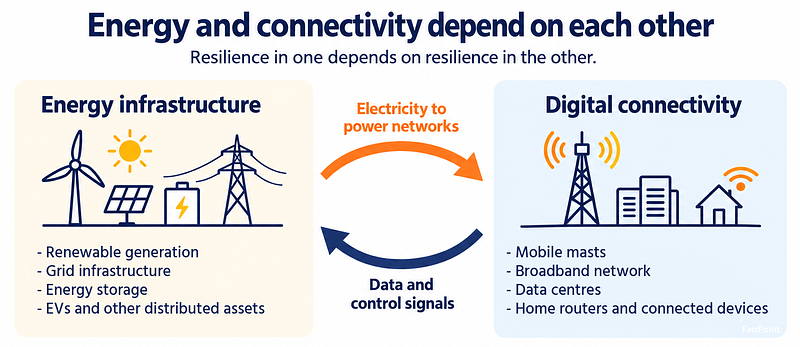
The UK energy sector is becoming increasingly dependent on reliable communications as the energy system transitions from a relatively centralised model to one that is more distributed, dynamic, and digitally enabled. The growth of renewable generation, battery storage, electric vehicles, and other distributed energy resources means network operators need much greater visibility into what is happening across their networks.
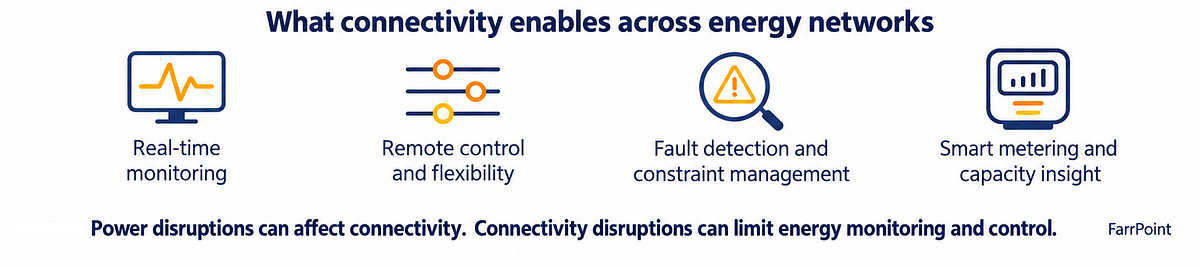
Sensors, remote monitoring and automated control systems rely on telecommunications networks to provide the real-time data needed to dispatch flexibility, manage constraints, identify faults and make effective use of network capacity, while smart meters add a growing volume of consumption data.
Remote substations, renewable generation sites, and other operational assets increasingly depend on connectivity for monitoring and control, while automation allows many activities that previously required manual intervention to be carried out remotely. As the energy system becomes more interconnected and data-driven, communications are shifting from a supporting service to a critical part of energy infrastructure itself.
A loss of connectivity can directly affect an operator’s ability to understand, manage and restore its network.
Rather than building capacity to meet every peak, operators are turning to batteries, electric vehicle charging, heat pumps and demand response from homes and businesses to shift or reduce demand when and where the network needs it.
But flexibility is only as dependable as the communications that underpin it; dispatch signals must reliably reach large numbers of distributed assets, and operations need confirmation that those assets have responded. Consider a constraint management scheme dependent on hundreds of EV chargers or domestic batteries. If communications fail during a system stress event, operators may lose access to flexibility that had been assumed available, potentially requiring alternative interventions at short notice. In a highly flexible energy system, lost communications may be equivalent to lost network capacity.
The widespread availability of high-quality commercial connectivity does not necessarily mean that it is sufficiently resilient for critical energy operations. Public mobile and fixed networks are designed to deliver high levels of service across large customer bases, but they are not engineered specifically to respond to the operational requirements of the energy system. Dependence on a single mobile operator, fibre provider or physical route can introduce single points of failure, while apparently diverse services may ultimately share the same ducts, exchanges, towers, transmission links or power supplies. From the energy operator’s perspective, two services can look independent while relying on the same physical assets.
The challenge becomes particularly important during major incidents, when energy operators may need communications most. Power outages can affect mobile sites and fixed network equipment, making service duration dependent on the availability of battery or generator backup. At the same time, severe weather or other incidents can damage infrastructure, disrupt multiple services and increase demand on the networks that remain available. These dependencies are often not visible, and the first sign of a shared weakness can be the simultaneous failure of services that were assumed to be independent.
When communications fail, the impact is operational. Network operators may lose access to real-time data from substations, sensors and other remote assets, reducing their ability to identify faults, monitor network conditions and remotely control equipment. Flexibility contracted to manage constraints may not be dispatched, or its delivery may not be visible. Automated processes may revert to local or manual operation, while control rooms can be left with an incomplete picture of what is happening across the network. Even when the underlying energy infrastructure continues to operate, losing communications can make it much harder to manage effectively, particularly during periods of high demand or disruption.
Telecommunications failures can also slow and complicate incident response. Field teams may struggle to receive work instructions, access operational information, or communicate with control centres and other teams, while operators may find it harder to prioritise faults and coordinate restoration activity. In a major incident affecting both power and telecommunications infrastructure, these problems can occur when rapid coordination and reliable information matter most. The consequences can include longer restoration times, increased operational and safety risks, and greater disruption for customers and other organisations that depend on the energy network.
Policy, regulation and technology changes are all increasing the dependency of energy operations on resilient communications. The UK’s clean power and net zero ambitions depend on a smarter, more flexible energy system, and Ofgem’s network price controls, including the RIIO-ED3 framework for electricity distribution, for example, place growing emphasis on digitalisation, data and resilience.
At the same time, changes in the telecoms market, such as the retirement of the copper telephone network and the switch-off of older 2G and 3G mobile networks, mean that operators will need to replace some legacy operational communications, whether they plan to or not.
Cyber security and communications resilience are two sides of the same issue. As more operational technology is connected, and more third parties, from flexibility aggregators to telecoms providers, sit in the data path, the attack surface grows. A cyber incident can take out communications just as effectively as a storm, and fallback arrangements need to work in both cases. Resilience planning should therefore cover not only physical diversity and backup power, but also network segmentation, secure remote access, supplier assurance and the ability to operate safely in a degraded or isolated mode.
Telecommunications resilience needs to be designed around the operational needs of the energy network rather than assumed from the availability of connectivity. This starts with understanding which applications, assets and operational processes depend on communications and how critical those dependencies are.
Organisations can then map the end-to-end communications that support them, including network providers, physical routes, shared infrastructure, power dependencies, and interfaces with third parties. This can reveal single points of failure that may not be obvious when considering individual communications services in isolation.
Not every application requires the same level of resilience, so the objective should not simply be to make every connection more robust. Operators need to define appropriate requirements for availability, recovery time and performance based on the operational consequences of losing each service. For the most critical functions, this may require genuinely diverse routes, alternative operators or technologies, independent power arrangements and tested fallback procedures.
Crucially, resilience should also be regularly tested and reviewed as networks, suppliers and operational requirements change. The aim is to understand where communications failure could materially affect operations and ensure that proportionate measures are in place before an incident occurs.
There is no single technology that can provide resilient communications for every energy application, location and operational scenario. Instead, resilience requires a multi-layered approach that combines fixed and public mobile networks with technologies such as private mobile networks, operational radio, and satellite or non-terrestrial networks (NTN).
Diverse fibre routes, multiple network operators, and alternative wireless technologies can provide additional protection against individual failures, while backup power is essential if communications services must remain available during wider electricity outages. The right combination depends on the application's criticality, location, and the consequences of communications being unavailable.
The energy transition is often discussed in terms of generation, networks and storage. Yet none of these can be operated effectively without trusted telecommunications. As the sector becomes increasingly digitalised, connectivity resilience is becoming one of the defining determinants of energy resilience itself.
Energy organisations should treat connectivity as part of their critical operational infrastructure. Understanding communications dependencies, identifying vulnerabilities, and designing proportionate resilience layers can reduce operational risk and improve response when disruption occurs. Ultimately, a more resilient energy system will depend not only on resilient generation, networks and assets, but also on the communications that connect and control them.
1. Which critical operations would be affected if a single communications service failed?
2. Do services that appear diverse share ducts, sites or power supplies?
3. Would the flexibility you are counting on still be dispatched if a communications network went down?
FarrPoint and Grid Scientific would be happy to help answer these questions.
Dr Andrew Muir is CEO and co-founder of FarrPoint, an independent digital connectivity consultancy operating across the UK and Canada. With over 30 years’ experience in telecommunications, he advises governments, regulators and industry on digital infrastructure strategy, policy and investment.
Eric Brown is Director of Grid Scientific and Professor of Practice in Energy Systems at the University of Strathclyde. A former Chief Technology Officer at the Energy Systems Catapult, he has extensive experience across the energy and telecommunications sectors, specialising in energy system transformation, digitalisation and the role of communications in enabling a resilient, low-carbon energy future.
FarrPoint is an independent technology consultancy working across the UK and Canada. Combining technical expertise with economic and commercial insight, the company helps public and private sector organisations plan, develop and deliver digital infrastructure, enabling better connectivity, stronger communities and economic growth.
Grid Scientific is an independent consultancy specialising in energy systems, digitalisation and technology innovation. The company supports organisations navigating the transition to a low-carbon energy system, with a focus on the integration of emerging technologies, smarter infrastructure and improved system resilience.
Connectivity is important. It drives business and society, bringing communities and commerce together. That's why we use our insight and experience to connect people and business.

