
By Kate Milne, Economist at FarrPoint
When we conduct economic appraisals, productivity is often one of the central outcomes we are trying to understand and improve. Whether assessing infrastructure investment, digital programmes or interventions, productivity sits at the heart of the case for change.
Productivity underpins long-term economic growth, living standards and competitiveness, and plays a critical role in determining how resilient national and local economies are to shocks. At the same time, weak productivity growth helps explain many of the challenges the UK faces today, from stagnant wages and fiscal pressures to widening regional inequalities. Improving productivity is therefore not just about efficiency, but about creating better outcomes for people and the places they live.
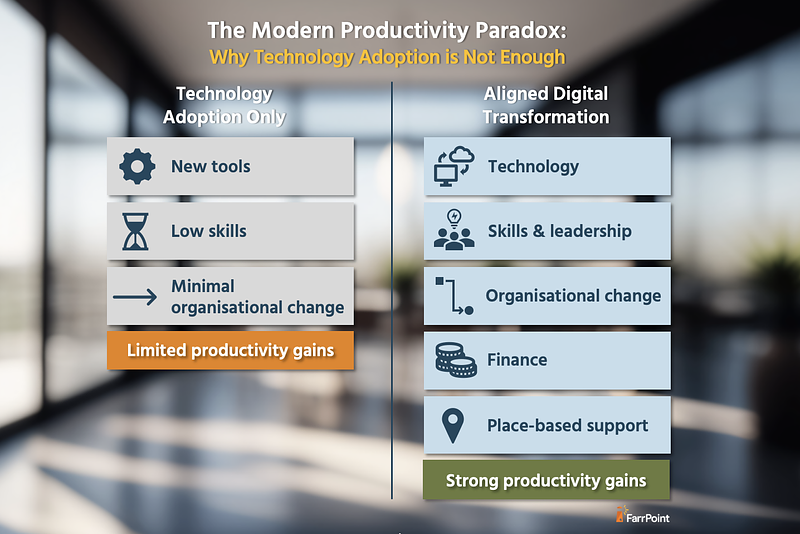
I was keen to learn more at last week’s Productivity for Better Outcomes event in Manchester, organised by (this will open in a new window)The Productivity Institute. The event brought together researchers, policymakers and practitioners to explore what actually drives productivity improvements in today’s economy. A clear and consistent message emerged throughout the day: technology adoption alone does not drive productivity. What matters is alignment - between technology, skills, organisations, finance and place. As digital and AI technologies continue to evolve at pace, closing this alignment gap is quickly becoming one of the UK’s most pressing productivity challenges.
Across sectors, firms are investing in advanced digital technologies but often fail to invest in the complementary capabilities needed to realise their value. Skills development, worker engagement, organisational change and aligned policy support are all critical to maximising the potential of digital. Without these, productivity gains remain limited, a phenomenon often described as the modern productivity paradox. Evidence presented at the event showed that the largest productivity improvements occur when deliberate technology choices are made and aligned with wider strategy, rather than treating digital tools as standalone upgrades.
The demand for digital skills, from basic digital literacy to advanced AI and data capabilities, continues to grow. However, supply is lagging, particularly outside major urban centres. Research tracking graduate pathways highlights a strong concentration of advanced digital and AI skills in the “golden triangle” of London, Oxford and Cambridge. This concentration is even more pronounced for AI-intensive roles. Crucially, advanced digital skills are most effective when combined with soft skills such as problem-solving and leadership, yet regional disparities in skill supply are widening.
Graduates often leave the locations where they are trained, making it harder for local firms to adopt and scale digital tools effectively. The implication is clear: skills policy must be more place-based and targeted, aligning education and training provision with local industry needs and long-term growth ambitions.
Digitalisation is not simply about deploying new systems. Research shows that digital technologies function as “affordance generators”, enabling organisations to rethink processes, business models and sustainability strategies.
Organisations that succeed are those that integrate digital tools into decision-making, adapt organisational structures alongside technology, and use digital capabilities to respond to risks, including climate and supply-chain disruption. By contrast, organisations that focus narrowly on implementation, without adaptation or alignment, frequently miss out on potential productivity gains.
Access to finance remains uneven across the UK, particularly for SMEs, start-ups and scale-ups outside the South East. The structure of the banking system, geographic risk perceptions and limited place-based investment mechanisms all play a role. The event highlighted a strong case for de-risking investment at a regional level and stronger local institutions that understand regional economic strengths. Without this, digital investment and productivity growth will continue to cluster geographically.
Knowledge diffusion – the spread of ideas, skills and innovation – is central to productivity growth. Regions tend to innovate most successfully in areas aligned with their existing industries and skills bases. A more balanced approach to R&D investment and stronger cross-regional linkages are needed to support diversification and allow emerging sectors, such as digital and clean energy, to grow beyond established hubs. Inequality is also a productivity issue. Spatial, neighbourhood and health inequalities reduce human capital and weigh on long-term growth. Short-term cost savings often create long-term economic drag.
A recurring theme was the UK’s complex governance landscape. Policy is often highly centralised yet fragmented in delivery. Some funding may be devolved, but with limited local control, weakening impact. True productivity gains depend on better coordination across national, regional and local levels, long-term industrial strategy with clear priorities, and giving local actors real powers to shape outcomes. Place-based strategies, when properly empowered, can unlock productivity by aligning infrastructure, skills, innovation and investment.
Digital connectivity is a foundational enabler of productivity, but its impact depends on how well it is aligned with skills, organisational capability and local economic strategy. Persistent gaps in broadband and mobile coverage, particularly in rural and remote areas, continue to limit firms’ ability to adopt digital tools effectively and to participate fully in increasingly digital value chains.
Strategic investment in high-speed broadband and resilient mobile networks is therefore essential not just for technical capability, but for widening access to opportunity. Connectivity supports more than technology deployment. It underpins remote and flexible working, expands access to skilled labour, and helps regions attract and retain talent in knowledge-intensive and innovation-led sectors.
However, infrastructure alone is not enough. Productivity gains materialise when connectivity is paired with digital inclusion, business support and place-based planning that ensures networks are designed around how communities and firms actually operate.
Approaches that combine infrastructure delivery with local insight, demand-side understanding and long-term regional objectives are critical to closing the alignment gap.
Whether supporting rural connectivity, city-region digital strategies or SME adoption, the message is consistent: technology works best when it’s embedded in a wider system, one that connects infrastructure to skills, policy, and local economic strengths.
Productivity is not just an economic metric. It shapes living standards, resilience and opportunity across regions and communities. It is clear, the path to better outcomes lies not in faster adoption, but in better alignment between technology, people and place. Reach out to us here at FarrPoint if you’d like to have a chat about this.
Connectivity is important. It drives business and society, bringing communities and commerce together. That's why we use our insight and experience to connect people and business.

.svg)