.jpg)
By Alan Pritchard, Principal Consultant at FarrPoint
For all the attention given to power, land, and planning in data centre development, fibre connectivity is often treated as something to be resolved later. This is a mistake because ignoring challenges in delivering data centre fibre can seriously impact delivery timelines.
In practice, connectivity should be considered at the beginning of the site selection process, not once a preferred location has been identified. Power availability undoubtedly will dominate the conversation, and land will shape what is physically possible. However, fibre availability and quantity will determine whether a site launches on time with the correct resilience and whether the development has the optimum commercially viability once operations begin.
This matters because connectivity is not only a technical utility but a strategic requirement. A site may appear attractive on paper, but if multiple diverse fibre routes are constrained, wayleaves are likely to prove difficult, or the surrounding network environment cannot support the capacity and resilience operators require, these issues can quickly become programme risks. By the time they are discovered, it may be too late to deliver the project on time.
This is especially important where delay has a very real cost. Research and consulting firm STL Partners reported in March 2025 that delays to a typical 60 MW data centre project can cost as much as $14.2 million (£11.2m) per month. Even if the exact figure varies by project, the underlying point is clear: anything that creates avoidable delay during delivery deserves scrutiny at the site selection stage, and the earlier it is identified, the more time there is to mitigate the impact.
There is a wider planning context that developers cannot afford to ignore. Our UK Local Government Connectivity Survey 2026 found that councils are asking for earlier engagement from operators, clearer national coordination, and better information to help them manage rollout and resilience challenges.
The same survey found that data centre development remains a relatively low priority for most councils, even after the sector’s designation as Critical National Infrastructure. More than a third of authorities said they are actively trying to attract data centre investment, and a further quarter are working directly with developers. However, only 15% reported carrying out formal economic appraisals of the benefits of data centre siting.
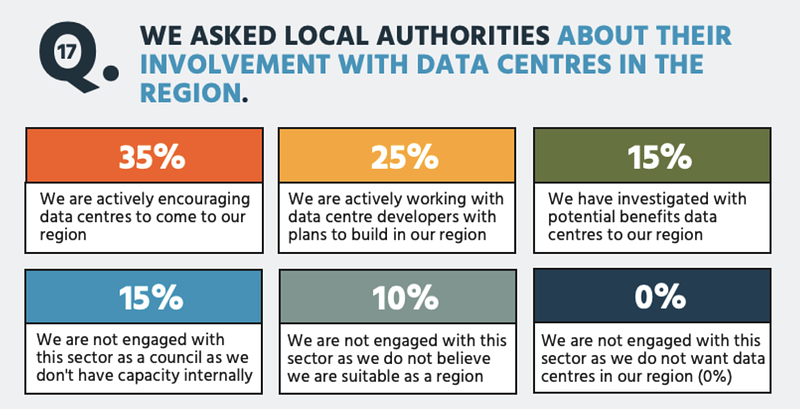
That combination should give the sector pause. On the one hand, there is genuine interest in attracting investment. On the other, data centres are not automatically understood, prioritised, or assessed in a consistent way at local level. In that environment, developers cannot assume that a strong power narrative will carry an application or smooth delivery. Connectivity, resilience, and local infrastructure readiness are all part of the picture.
Fibre connectivity should be treated as a front-end issue. Early connectivity diligence helps answer questions that become far more difficult later, such as:
These are all important parts of determining whether a site is genuinely ready for development in the timescale desired.
Early assessment also improves conversations with planners, local authorities, and infrastructure partners. If a developer can show that connectivity has been examined seriously alongside power, transport, and environmental considerations, the project is in a much stronger position. It signals that digital infrastructure has been considered holistically rather than assumed.
There is a broader lesson here as the market continues to grow. The most successful data centre developments are unlikely to be those that identify power and hope the rest falls into place. Instead, they will recognise infrastructure readiness as a package, with fibre connectivity considered early in the process.
In other words, the question is not whether connectivity matters, but whether it is considered early enough. If it is not factored into the initial investment decision, timescales can slip and the site may not succeed at all.
Contact FarrPoint for more information on how we can help assess and improve connectivity for project success.
Connectivity is important. It drives business and society, bringing communities and commerce together. That's why we use our insight and experience to connect people and business.

.svg)