By (this will open in a new window)Abbie McGowan, Senior Economist, and (this will open in a new window)Alan Pritchard, Head of Data Centres at FarrPoint.

The cloud services businesses rely on, the social media and online shopping that residents use, and the AI tools now embedded in our workplaces and smart devices all rely upon data centres.
In 2024, 54% of UK adults used AI tools, (this will open in a new window)Ofcom reports. In 2026, these figures are no doubt even higher. Our demand for digital services continues to grow, and the infrastructure supporting it correspondingly requires a home.
However, not every data centre development is right for every location, and residents increasingly want to understand the implications for electricity, water, land, heat, noise and their communities. For local authorities, the challenge is to assess these transparently while assessing how investment can deliver long-lasting regional value.
FarrPoint believes every region needs a strategy for benefiting from AI, whether or not it hosts a major infrastructure facility.
Some locations will always be more attractive to developers than others. Available power, connection timescales, fibre connectivity and density, suitable land, proximity to other Data Centres, and customer requirements all influence investment decisions. Different facilities also have different needs: a large AI training campus and a data centre serving latency-sensitive businesses are not interchangeable.
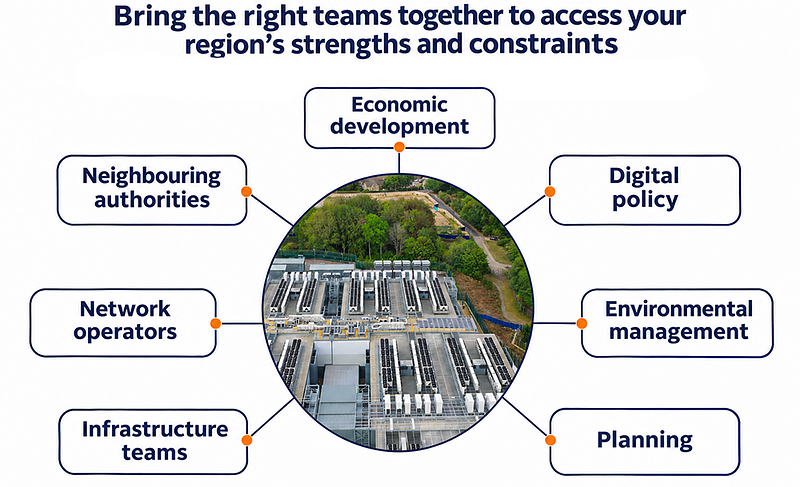
Authorities should assess their region’s strengths and constraints before committing resources to attracting investment. This means bringing economic development, digital policy, environmental management, planning and infrastructure teams together, alongside network operators and neighbouring authorities to assess the place-based opportunity their region affords. A credible proposition starts with understanding what is technically feasible, commercially attractive and place appropriate.
The response to the UK Government’s AI Growth Zones programme demonstrated strong regional ambition. In 2025, the initial call attracted more than 200 expressions of interest across the UK, with local authorities putting forward areas as potential hosts.
Not every proposal will become a fully developed Growth Zone. However, areas with credible potential should investigate what hosting would mean locally: the infrastructure required, the pressures it could create and the benefits realistically available to residents and businesses.
That evidence can guide investment and economic development decisions, whether formal designation follows.
FarrPoint’s economists and data centre specialists supported Buckinghamshire Council with this type of assessment: reviewing the local data centre market, potential economic and societal benefits, infrastructure constraints and opportunities at council-identified sites. The findings provided evidence to inform the council’s strategic approach to data centre development. We have also been supporting the UK's First AI Growth Zone in Culham on the resilience requirements of their AI data centre, so we've seen a growth zone develop from the very start.
A substantial capital investment does not automatically translate into local economic prosperity. Authorities need to understand which benefits will reach their communities, when they will arrive, who they will benefit and their long-term sustainability.
An economic assessment should distinguish temporary construction employment from permanent operational job creation and wider supply-chain effects.
It should determine how much spend is likely to be retained within the local economy, whether residents have the necessary skills to take up jobs, and whether activity is genuinely additional or displaced from elsewhere.
The assessment should also consider alternative uses of scarce land and electricity capacity. Comparing realistic scenarios gives decision makers a stronger basis for judging value than headline figures.
Realising desired benefits requires a robust monitoring and delivery plan, outlining named partners and stakeholders and their associated responsibilities, funding requirements, key milestones and measurable commitments.
Depending on the development, priority benefits could include increased productivity and business growth, job creation and employment opportunities, apprenticeships and skills development and local supply chain opportunities. Early engagement matters: local suppliers need to be aware of upcoming opportunities and have adequate time to prepare to meet procurement requirements before contracts become available.
Infrastructure opportunities also need scrutiny. Fibre investment will only improve wider connectivity if networks and commercial arrangements target that outcome. Waste heat reuse requires suitable nearby demand, viable distribution infrastructure and an agreed business model. Neither can be assumed simply because a data centre is planned.
Regions without a major data centre can still benefit from the services this infrastructure enables. Equally, hosting a facility does not automatically give nearby businesses affordable computing access or the capability to use AI effectively.
For many authorities, the practical opportunity is to help existing sectors adopt digital tools productively. That could mean supporting manufacturers with data analysis, helping smaller businesses use cloud services securely, or connecting universities with local employers.
Reliable broadband and mobile connectivity, workforce skills and targeted business support are essential foundations. Regional collaboration can connect these activities with investment elsewhere, widening participation without requiring every authority to compete for the same development.
Public confidence depends on evidence. Authorities should seek clear, site-specific information on resource use and environmental impacts, alongside realistic benefit forecasts. They should establish a baseline, agree reporting responsibilities and track outcomes as projects move from construction into operation.
Success should be judged through visible results residents can see; accessible jobs, local contracts, improved skills and stronger businesses. Publishing progress, including where commitments fall short, makes the relationship between development and community benefit more transparent.
FarrPoint can help authorities turn these questions into an evidence-led regional strategy. Combining our data centre, digital infrastructure and economics expertise, we can assess investment readiness, identify constraints, evaluate the scale and nature of economic and social benefits, and develop practical plans for delivering and measuring benefits. This gives local leaders an independent basis for engaging with developers and making decisions that reflect their priorities.
FarrPoint has been working with both local government and data centre developers for years; we are well placed to assist and independently evaluate your location's suitability for new digital infrastructure. Get in touch with us to discuss your requirements and to hear what we've already learnt from working with our clients.

Buckinghamshire Council were very keen to explore the economic opportunities that data centres may present. FarrPoint provided us with a very clear and comprehensive report, along with recommendations for how we can capitalise on these opportunities. This report has aided us with decision making in this area and is being utilised as evidence to support the council’s strategic approach to data centre delivery in Buckinghamshire.
LLOYD LITTLE, DIGITAL INFRASTRUCTURE AND INNOVATION LEAD AT BUCKINHAMSHIRE COUNCILConnectivity is important. It drives business and society, bringing communities and commerce together. That's why we use our insight and experience to connect people and business.

